

22
Oct
2026
18:00
Vortrag auf Deutsch!
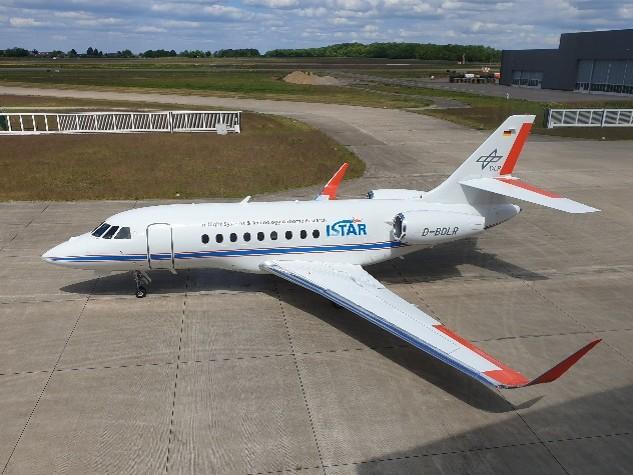
Das DLR betreibt mit 11 Flugzeugen die größte Flotte an Forschungsflugzeugen in Europa. Das neueste Mitglied – die Dassault Falcon 2000LX - ist unter dem Namen "ISTAR – In-Flight Systems and Technologies Airborne Research" seit dem 31. Januar 2020 im Einsatz. Mit ISTAR besitzt das DLR einen Flugversuchsträger, mit dem an neuen Technologien gearbeitet wird, neue Flugzeuge simuliert werden sollen und die Digitalisierung der Luftfahrt weiter vorangetrieben wird. ISTAR erhielt in Braunschweig zunächst eine Basismessanlage zur Bündelung und Bereitstellung verschiedenster Flugdaten. Arbeitsplätze für Flugversuchsingenieure, die an Bord Experimente steuern und Flugparameter überwachen, wurden ebenfalls bereits eingebaut.
Der Vortrag beschreibt zu Beginn die Phase von der ersten Idee bis zum Roll-out am
20.02.2020 in Braunschweig. Im Mittelteil wird der Integration des experimentellen Eingriffs in die Flugsteuerung über die standardmäßig eingebaute Autopilotenkomponenten detailliert erläutert. Am Ende werden dann noch exemplarisch erste wissenschaftlichen ISTAR- Flugversuche kurz vorgestellt.
Zum Lebenslauf von Martin Gestwa
Seit 1988 im Deutschen Zentrum für Luft- und Raumfahrt (DLR) tätig.
1988 bis 1997 Mathematisch-technischen Assistenten anschließend Studium der Informatik an der TU Braunschweig.
1997 bis 2007 Institut für Flugsystemtechnik in der Abteilung Simulationstechnik.
2008 Abteilung Hubschrauber
2013 Leiter der Gruppe „FHS & Flugregelung“ in der Abteilung Hubschrauber.
2018 Leitung der Forschungsflugabteilung in Braunschweig. und Betriebsleiter für die Instandhaltung und für die Aufrechterhaltung der Lufttüchtigkeit der DLR-Forschungsflotte.
 poster_2026_10_22_ISTAR.pdf (387 KB)
Date:
Time:
Time:
22.10.2026
18:00 Uhr
18:00 Uhr
Add to Calendar:
Speaker:
Dipl.-Inform. Martin Gestwa, Leiter Technikbetrieb und Forschungsflugabteilung,
Deutsches Zentrum für Luft- und Raumfahrt (DLR)
Location:
HAW Hamburg, Berliner Tor 5, Hörsaal 01.10 (in-person only!)
Contact:
Richard Sanderson 
28
Oct
2026
13:00
Date:
Time:
Time:
28.10.2026
13:00 - 14:00 Uhr
13:00 - 14:00 Uhr
Add to Calendar:
Speaker:
Prof. Dr. Ian Poll,
Emeritus Professor at Cranfield University
Location:
Online
Contact:
Richard Sanderson
29
Oct
2026
18:00
Lecture in English
Access to space is changing. Falling launch costs, smaller spacecraft and increasingly accessible technologies are opening opportunities that would have been almost unimaginable for student teams only a few decades ago. Today, students can design, build and test experiments, rockets and satellites to gain hands-on experience long before entering the aerospace industry.
The newly founded Hamburg Space Team (HST), brings this opportunity to Hamburg: today, around 70 students from mechanical and electrical engineering to physics and more, take genuine responsibility for complex engineering work, from design to flight
In this Lecture, we will give an inside look at how HST was built, along the way, we will present some of the projects currently being developed within HST — including student-built rocket experiments, satellite projects and launch vehicle development — and discuss the engineering and organisational challenges behind them.
The lecture will also look beyond Hamburg. Student aerospace initiatives are increasingly becoming an important part of Europe’s space ecosystem being the training grounds for future space engineers, as platforms for rapid experimentation and, in some cases, as the origins of new companies and technologies.
Ultimately, the talk asks a simple question: how far can students go when they are given the opportunity to build, test and launch for real?
About the speakers
Mika Schultes is a member of the board of Hamburg Space Team and mission Lead of BOLT. Since 2024 he has been studying for Bachelor of Science Mechanical Engineering at TUHH.
Thorbjörn Albrecht, Mission Lead of HANS, studying for Master of Science mechatronics at TUHH
Simon Reininghaus Head of the Board Hamburg Space Team, studying for Bachelor of Science Mechanical Engineering.
poster_2026_10_29_Hamburg_Space_Team.pdf (276 KB)
Date:
Time:
Time:
29.10.2026
18:00 Uhr
18:00 Uhr
Add to Calendar:
Speaker:
Mika Schultes, Hamburg Space Team and other speakers
Location:
HAW Hamburg, Berliner Tor 5, Hörsaal 01.10 (in-person only!)
Contact:
Richard Sanderson
04
Nov
2026
13:00
Date:
Time:
Time:
04.11.2026
13:00 - 14:00 Uhr
13:00 - 14:00 Uhr
Add to Calendar:
Speaker:
Dr.-Ing. Tim Wittmann,
Development Engineer, Airbus
Location:
Online
Contact:
Richard Sanderson
11
Nov
2026
13:00
Date:
Time:
Time:
11.11.2026
13:00 - 14:00 Uhr
13:00 - 14:00 Uhr
Add to Calendar:
Speaker:
Jonathon Counsell,
IAG Group Director of Sustainability
Location:
Online
Register below
Contact:
Richard Sanderson
18
Nov
2026
13:00
Date:
Time:
Time:
18.11.2026
13:00 - 14:00 Uhr
13:00 - 14:00 Uhr
Add to Calendar:
Speaker:
Grazvydas Bajoras,
Director, iFuel Ltd
David Arinze,
Managing Director, Shaphargroup, LLC Netherlands
Location:
Online
Contact:
Richard Sanderson
25
Nov
2026
13:00
Date:
Time:
Time:
25.11.2026
13:00 - 14:00 Uhr
13:00 - 14:00 Uhr
Add to Calendar:
Speaker:
Dr. Paul Hodgson,
Blue Skies, Google Technical Lead
Location:
Online
Contact:
Richard Sanderson
26
Nov
2026
18:00
Lecture in English
Active control of air flow over aircraft wings can significantly improve aerodynamic performance. Pulsed jet actuation is a particularly promising technology – compared to steady jet injection, it can suppress flow separation much more effectively with reduced mass flow. Outcomes from the Clean Sky 2 WINGPULSE project will be presented, which was aimed at demonstrating pulsed jet actuator concepts for flow separation control that exceed the state-of-the-art – namely, those that reduce the net mass flow by a factor of at least 3. Results from wind tunnel testing and high-fidelity simulations will be described.
Mark Jabbal was Principal Investigator on the WINGPULSE project. His main research interests are in fluid flow control for drag reduction (experimental aerodynamics; optimization and vehicle system integration studies). He is also a co-opted member and Vice Chair of the Royal Aeronautical Society Aerodynamics Specialist Group. Mark has both MEng and PhD degrees in Aerospace Engineering from the University of Manchester.
Date:
Time:
Time:
26.11.2026
18:00 Uhr
18:00 Uhr
Add to Calendar:
Speaker:
Mark Jabbal PhD MEng MRAeS, University of Nottingham
Location:
HAW Hamburg, Berliner Tor 5, Hörsaal 01.10 (in-person only!)
Contact:
Richard Sanderson
Date:
Time:
Time:
01.12.2026
18:00 Uhr
18:00 Uhr
Add to Calendar:
Location:
Anglo-German Club, Harvestehuder Weg 44, 20149 Hamburg.
Contact:
Richard Sanderson
21
Jan
2027
18:00
Date:
Time:
Time:
21.01.2027
18:00 Uhr
18:00 Uhr
Add to Calendar:
Speaker:
Florian Prinz M.Sc.,
Head of Engine Life Cycle Services, Lufthansa Technik
Location:
HAW Hamburg, Berliner Tor 5, Hörsaal 01.10 (in-person only!)
Contact:
Richard Sanderson